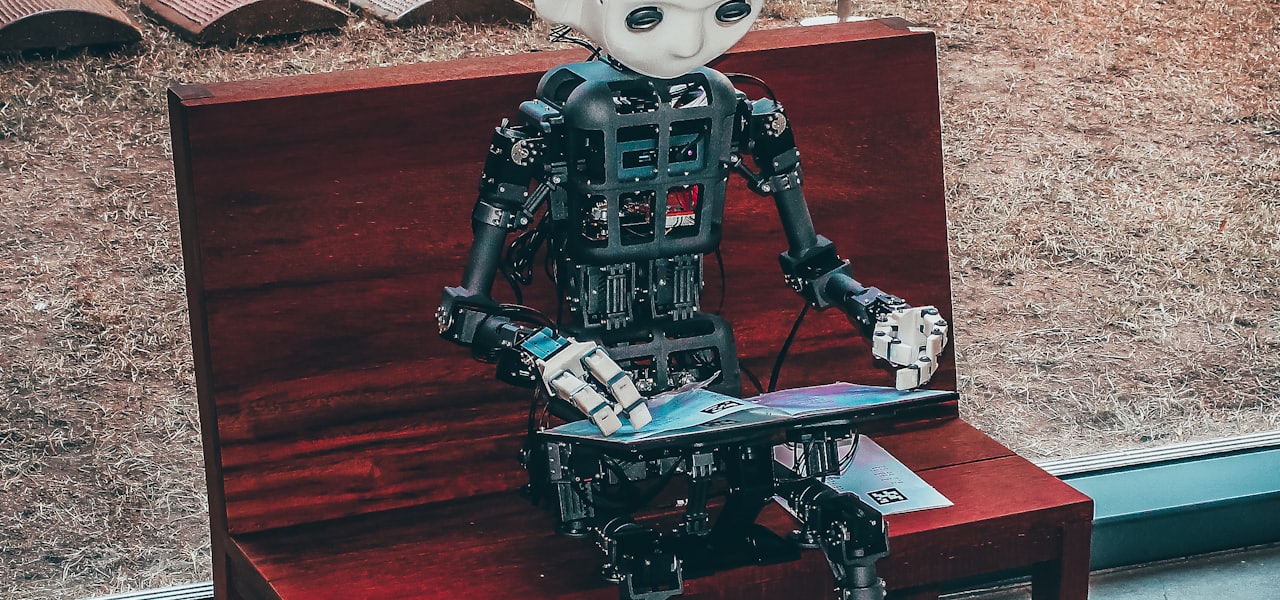
A learning automaton is one type of machine learning algorithm studied since 1970s. Learning automata select their current action based on past experiences from the environment. It will fall into the range of reinforcement learning if the environment is stochastic and a Markov decision process (MDP) is used. == History == Research in learning automata can be traced back to the work of Michael Lvovitch Tsetlin in the early 1960s in the Soviet Union. Together with some colleagues, he published a collection of papers on how to use matrices to describe automata functions. Additionally, Tsetlin worked on reasonable and collective automata behaviour, and on automata games. Learning automata were also investigated by researches in the United States in the 1960s. However, the term learning automaton was not used until Narendra and Thathachar introduced it in a survey paper in 1974. == Definition == A learning automaton is an adaptive decision-making unit situated in a random environment that learns the optimal action through repeated interactions with its environment. The actions are chosen according to a specific probability distribution which is updated based on the environment response the automaton obtains by performing a particular action. With respect to the field of reinforcement learning, learning automata are characterized as policy iterators. In contrast to other reinforcement learners, policy iterators directly manipulate the policy π. Another example for policy iterators are evolutionary algorithms. Formally, Narendra and Thathachar define a stochastic automaton to consist of: a set X of possible inputs, a set Φ = { Φ1, ..., Φs } of possible internal states, a set α = { α1, ..., αr } of possible outputs, or actions, with r ≤ s, an initial state probability vector p(0) = ≪ p1(0), ..., ps(0) ≫, a computable function A which after each time step t generates p(t+1) from p(t), the current input, and the current state, and a function G: Φ → α which generates the output at each time step. In their paper, they investigate only stochastic automata with r = s and G being bijective, allowing them to confuse actions and states. The states of such an automaton correspond to the states of a "discrete-state discrete-parameter Markov process". At each time step t=0,1,2,3,..., the automaton reads an input from its environment, updates p(t) to p(t+1) by A, randomly chooses a successor state according to the probabilities p(t+1) and outputs the corresponding action. The automaton's environment, in turn, reads the action and sends the next input to the automaton. Frequently, the input set X = { 0,1 } is used, with 0 and 1 corresponding to a nonpenalty and a penalty response of the environment, respectively; in this case, the automaton should learn to minimize the number of penalty responses, and the feedback loop of automaton and environment is called a "P-model". More generally, a "Q-model" allows an arbitrary finite input set X, and an "S-model" uses the interval [0,1] of real numbers as X. A visualised demo/ Art Work of a single Learning Automaton had been developed by μSystems (microSystems) Research Group at Newcastle University. == Finite action-set learning automata == Finite action-set learning automata (FALA) are a class of learning automata for which the number of possible actions is finite or, in more mathematical terms, for which the size of the action-set is finite.
Mobile simulator
A mobile simulator is a software application for a personal computer which creates a virtual machine version of a mobile device, such as a mobile phone, iPhone, other smartphone, or calculator, on the computer. This may sometimes also be termed an emulator. The mobile simulator allows the user to use features and run applications on the virtual mobile on their computer as though it was the actual mobile device. A mobile simulator lets you test a website and determine how well it performs on various types of mobile devices. A good simulator tests mobile content quickly on multiple browsers and emulates several device profiles simultaneously. This allows analysis of mobile content in real-time, locate errors in code, view rendering in an environment that simulates the mobile browser, and optimize the site for performance. Mobile simulators may be developed using programming languages such as Java, .NET and JavaScript.
Tresorit
Tresorit is a Swiss company providing end-to-end encrypted cloud storage and secure content collaboration services. Founded in 2011, the company primarily serves businesses and organizations with elevated data protection and compliance requirements. Since 2021, Tresorit has been part of Swiss Post's digital business services, which, under the name 'Swiss Post Digital' offer secure communication platforms and connectable software solutions for SMEs, public authorities, and the healthcare sector, among others. == History == Tresorit was founded in 2011 by Hungarian software developers Istvan Lam, Szilveszter Szebeni and Gyorgy Szilagyi with the aim of providing a secure alternative to traditional cloud storage solutions. The company developed a cloud collaboration platform based on client-side end-to-end encryption and a zero-knowledge architecture. In its early years, Tresorit gained attention through a public security challenge inviting researchers to attempt to compromise its encryption system. The initiative received coverage in technology and cybersecurity media. The company initially positioned itself as a secure alternative to conventional cloud storage services and gradually expanded its offering toward enterprise-focused collaboration tools. In 2021, Swiss Post Communications Services acquired a majority stake in Tresorit. The company is now part of Swiss Post, and continues to operate independently within Swiss Post’s digital division, while benefiting from the broader infrastructure and institutional framework of its parent organization. Tresorit has offices in Zurich, Munich, and Budapest. == Products and Services == Tresorit provides a cloud-based platform for secure file storage and collaboration. Its services include encrypted file sharing, email encryption, electronic signatures, and encrypted data rooms for managing sensitive documents and workflows. The platform is available on Windows, macOS, Linux, Android, and iOS. == Technology == Tresorit uses client-side end-to-end encryption based on a zero-knowledge model. Files are encrypted on the user’s device before being uploaded to company servers. According to the company, encryption keys remain under user control, meaning that Tresorit and third parties cannot access the content of stored files. == Security challenge == Between 2013 and 2014, Tresorit organized a public challenge inviting security researchers to attempt to compromise the service's encryption implementation. The challenge received coverage in technology and cybersecurity media. == Acquisition by Swiss Post == In 2021, Swiss Post Communications Services acquired a majority stake in Tresorit as part of Swiss Post’s broader digital services strategy. The company is now part of Swiss Post. == Reception == Tresorit has been covered by international technology and business publications in the context of secure cloud storage and encrypted collaboration services. TechCrunch described the company as an early European provider of end-to-end encrypted cloud services, while The New York Times included it in discussions of secure file-sharing tools. Other publications such as TechRadar and ITPro have reviewed Tresorit in the context of enterprise security and confidential data handling.
Dating app
An online dating application, commonly known as a dating app, is an online dating service presented through a mobile phone application. These apps often take advantage of a smartphone's GPS location capabilities, always on-hand presence, and access to mobile wallets. These apps aim to speed up the online dating process of sifting through potential dating partners, chatting, flirting, and potentially meeting or becoming romantically involved. Online dating apps are now mainstream in the United States. As of 2017, online dating (which included both apps and other online dating services) was the principal method by which new couples in the U.S. met. The percentage of couples meeting online is predicted to increase to 70% by 2040. == Origins == The first computerized dating service was launched in 1964, the St. James Computer Dating Service, which became known as Com-Pat. The first U.S. dating service that used computerized match making was Operation Match. It required men and women to complete a questionnaire and was launched in 1965. Operation Match inspired the methodology of Dateline, which became popular in the 1970s and 1980s. Match.com was launched in 1995 and turned computerized match making into a profitable business. Grindr targeted gay and bisexual men at launch. Tinder, launched in 2012, led to a growth of online dating applications by both new providers and existing online dating services that expanded into the mobile app market. == Usage by demographic group == Online dating applications typically target a younger demographic group, though some apps, like Senior Match and Silver Singles are geared toward the 50 and up demographic. In 2016, almost 50% of people knew of someone who use the services or had met their loved one through the service. After the iPhone launch in 2007, online dating data has mushroomed as application usage increased. In 2005, only 10% of 18-24 year olds reported to have used online dating services; this number quickly grew to over 27%, making this target demographic the largest number of users for most applications. When Pew Research Center conducted a study in 2016, they found that 59% of U.S. adults agreed that online dating is a good way to meet people compared to 44% in 2005. This explosion in usage can be explained by the increased use of smartphones. By the end of 2022, it is expected there will be 413 million active users of online dating services worldwide. A 2023 Pew Research Center survey of 6,034 American adults found that 30% had ever used an online dating site or app, including 53% of those aged 18 to 29, 37% of those aged 30 to 49, and 17% of those aged 50 and over. Lesbian, gay and bisexual respondents reported using dating apps at nearly twice the rate of straight respondents (51% versus 28%), and 36% of divorced, separated or widowed adults had used one, compared with 16% of married adults. The increased use of smartphones by those 65 and older has also driven that population to the use dating apps. The Pew Research Center found that usage increase by 8 points since last surveyed in 2012. A study in 2021 found that more than one-third of seniors have dated in the past 5 years, and roughly one-third of those dating seniors have turned to dating apps. During the COVID-19 pandemic, Morning Consult found that more Americans were using online dating apps than ever before. In one survey in April 2020, the company discovered that 53% of U.S. adults who use online dating apps have been using them more during the pandemic. As of February 2021, that share increased to 71 percent. Research using Hofstede's cultural dimensions theory has indicated that norms about online dating applications tend to differ across cultures. A study published in the Journal of Creative Communications looked into the relationships between dating-app advertisements from over 51 countries and the cultural dimensions of these countries. The results revealed that dating-app advertisements appealed to multiple cultural needs, including the needs for relationships, friendship, entertainment, sex, status, design and identity. The use of these appeals was found to be 'congruent with ... the individualism/collectivism and uncertainty avoidance cultural dimensions.' == Popular applications == Following Tinder's success, other companies released dating applications. Raya was released in 2015 as a membership-based dating app, allowing entrance only through referrals, which was marketed as a dating app for celebrities. In early 2026, Hily surpassed Bumble to become the third most-used dating application in the United States and the fifth highest-grossing overall, driven largely by growing popularity among Generation Z users, while remaining behind Tinder and Hinge, both owned by Match Group. A number of dating apps have been created targeting adherents of particular religions seeking partners of the same religion, such as Muzmatch for Muslims, Christian Mingle, SALT, and Christian Connection for Christians, and JSwipe and JDate for Jews. === VR Dating === VR Dating is an application of Social VR where people can exist, collaborate, and perform various activities together. Virtual reality apps use virtual and augmented realities to make the dating experience more lifelike and more effective, as well as allow people to expand what is already possible in the world of online dating. There are several online platforms of VR Dating. The VR dating app Nevermet is the VR equivalent of Tinder, where people can search and find on dates. However, instead of actual real-life pictures, users will update pictures of virtual selves and will be interacting with avatars rather than real faces. Flirtual is a self-contained social VR app that serves to match users who then decide where and how to meet in VR. Flirtual hosts speed dating and social events in VR. == Effects on dating == The usage of online dating applications can have both advantages and disadvantages: === Advantages === Many of the applications provide personality tests for matching or use algorithms to match users. These factors enhance the possibility of users getting matched with a compatible candidate. Users are in control; they are provided with many options so there are enough matches that fit their particular type. Users can simply choose to not match the candidates that they know they are not interested in. Narrowing down options is easy. Once users think they are interested, they are able to chat and get to know the potential candidate. This form of communication can reduce the time, cost, and uncertainty often associated with traditional dating methods. Online dating offers convenience; people want dating to work around their schedules. Online dating can also increase self-confidence; even if users get rejected, they know there are hundreds of other candidates that will want to match with them so they can simply move on to the next option. In fact, 60% of U.S. adults agree that online dating is a good way to meet people and 66% say they have gone on a real date with someone they met through an application. Today, 5% of married Americans or Americans in serious relationships said they met their significant other online. The 39% of online dating users (representing 12% of all U.S. adults) say they have been in a committed relationship or married someone they met on a dating site or app. ==== Rejection sensitive individuals ==== Individuals high in rejection sensitivity are more likely to use online dating applications. As they tend to expect, perceive and overreact to rejection, rejection sensitive individuals struggle with traditional dating. Online dating applications allow for them to better reveal their true selves, potentially increasing their dating success. Online dating applications also obscure rejection cues, alleviating the rejection-related distress experienced by rejection sensitive individuals. ==== Anxiously attached individuals ==== Individuals high in attachment anxiety are also more likely to use online dating applications. While they harbour negative self-views, anxiously attached individuals are also more eager to enter and commit to relationships. Online dating applications allow for them to present "an authentic yet ideal version of themselves", mitigating their tendencies to view themselves as undesirable. This increases their romantic confidence, and potentially alleviates their anxiety when searching for a romantic partner. === Disadvantages === Sometimes having too many options can be overwhelming. With so many options available, users can get lost in their choices and end up spending too much time looking for the "perfect" candidate instead of using that time to start a real relationship. In addition, the algorithms and matching systems put in place may not always be as accurate as users think. There is no perfect system that can match two people's personalities perfectly every time. Communication online also lacks the physical chemistry aspec
Parasolid
Parasolid is a geometric modeling kernel originally developed by Shape Data Limited, now owned and developed by Siemens Digital Industries Software. It can be licensed by other companies for use in their 3D computer graphics software products. Parasolid's abilities include model creation and editing utilities such as Boolean modeling operators, feature modeling support, advanced surfacing, thickening and hollowing, blending and filleting, and sheet modeling. It also incorporates modeling with mesh surfaces and lattices. Parasolid also includes tools for direct model editing, including tapering, offsetting, geometry replacement and removing feature details with automated regeneration of surrounding data. Parasolid also provides wide-ranging graphical and rendering support, including hidden-line, wireframe and drafting, tessellation, and model data inquiries. To use Parasolid effectively, software developers need knowledge of CAD in general, computational geometry, and topology. Parasolid is available for Windows (32-bit, 64-bit and AArch64), Linux (64-bit and AArch64), macOS (Apple silicon and Intel), iOS, and Android. == Parasolid XT format == Parasolid parts are normally saved in XT format, which usually has the file extension .X_T. The format is documented and open. There is also a binary version of the format, usually with an .X_B extension, which is somewhat more compact. Both .X_T and .X_B are used for parts files. == Applications == It is used in many computer-aided design (CAD), computer-aided manufacturing (CAM), computer-aided engineering (CAE), product visualization, and CAD data exchange packages. Notable uses include:
EffectsLab Pro
EffectsLab Pro is a discontinued visual effects software product developed by FXhome. It has since been superseded by the FXhome HitFilm range. The company also produced a limited functionality version, EffectsLab Lite, containing just the Particle engine. A more extensive product, VisionLab Studio, combined the functionality of EffectsLab Pro and the company's CompositeLab Pro product with enhancements to both. == Effects Engines == The effects are generated by the program's effect engines: The Neon Light engine allows light beams to be drawn onto the video, allowing the generation of lightsaber-like weapons, neon lighting, fantasy glow effects and laser blasts. The Particle engine is used for particle effects, such as smoke, fire, explosions, and weather effects. The Muzzle Flash engine is designed for creating and animating muzzle flashes such as machine gun firing, tank blasts, etc. It's possible to rotate the created muzzle flash in 3D, making it the only engine with 3D use. The Optics engine is designed for creating artificial lens flares and light sources. It is useful for enhancing other light-based effects, and mimicking the distinctive flashes of light that accompany Star Wars' lightsaber battles. The Laser engine (introduced in EffectsLab Pro in late 2007) is designed as a simplified method of creating laser weapon effects, including the ability to add simulated perspective to the effect. == Presets == EffectsLab Pro allows the user to save the effects using presets. Since all effects are generated from settings in the different engines, it is fairly easy to generate an XML style description of the effect. It is also possible to share presets on FXhome's website.
LENA Foundation
The LENA Foundation is an American nonprofit organisation which provides tools for measuring children's language acquisition and exposure. Specifically, the LENA system consists of a digital language processor which is worn by a child and records and analyses their auditory environment, using propriety software. It then presents a summary of child-adult conversation, such as conversation turns and word counts. The purpose of the LENA system is to encourage interactive talk between children (between the age of two to forty-eight months) and their caretakers. The LENA system is also used for research; while useful for researchers who wish to save transcription costs or observe the child in its natural state, the accuracy of this system, while often quite high, varies between contexts, for example notably in the case of hard of hearing children. Because of this, several researchers recommend caution in using only the LENA system on its own for the purposes of scientific research. == History == The LENA Foundation was established in 2009 by Terrance and Judith Paul, founders of Renaissance Learning, Inc., with the purpose of aiding children with disabilities and assisting with early learning. They were inspired by the book "Meaningful Differences in the Everyday Experience of American Children" by Dr. Betty Hart and Dr. Todd Risley. A pilot version of the LENA system was launched in February 2006. The LENA Research Foundation was registered as a tax-exempt 501(c)(3) nonprofit in September 2010. The organisation was renamed simply LENA in 2018 and adopted the tagline "Building brains through early talk." LENA has been used for parental feedback, linguistics or paediatrics research, and for specific clinical cases. == Scientific background == In 2018, research using the LENA system showed that there was a link between children's conversational turns and activation of Broca's area (a part of the brain responsible, although not necessarily essential, for language processing). The LENA foundation cites research by its own employees as evidence for the scientific basis of its technology. Said research claims that verbal interaction with young children has an effect on language acquisition, including verbal comprehension skills during adolescence. == LENA System == The LENA software analyses a child's natural language environment, such as verbal exposure, and provides several metrics, such as adult and child speech time, television/recorded audio time, word count, or conversation turn count. The LENA hardware is a recorder that is usually placed into a child's specially-designed vest. The software was trained on over 65,000 hours of manually annotated American English audio recordings. It splits the audio into segments which are categorised as "key child", "other child", "male adult", "noise", etc. The advantages of LENA as opposed to manual transcription are its speed and ease of use; the disadvantages are its potential inaccuracies and lack of transcription capability (which LENA does not profess to attempt). The LENA system has also been criticised for prioritising quantity of speaking over quality (i.e., mastery of the language, as opposed to babble). == Product lines == === LENA Start === LENA Start is a program for parents that utilises feedback from the LENA System in conjunction with weekly group sessions in order to address the home language environment. It was introduced in 2015 and implemented across several U.S. states. In October 2020, during the restrictions of the COVID-19 pandemic, Read Aloud Delaware began a virtual LENA Start program with families statewide, where parents received feedback and participated in one-hour Zoom workshops each week during the 10-week program. === LENA Grow === LENA Grow is a professional development program for teachers in early childhood classrooms. Before launching at sites around the country, the program was first piloted in Escambia County, Florida. === LENA Home === LENA Home is a supplement to existing parent coaching curricula. Typically, home visitors facilitate the use of the LENA System to help parents track their progress towards increasing interactive talk in their homes. === Developmental Snapshot === The LENA Developmental Snapshot, based on a 52-question parent survey, assesses both expressive and receptive language skills and provides an estimate of a child's developmental age from 2 months to 36 months.